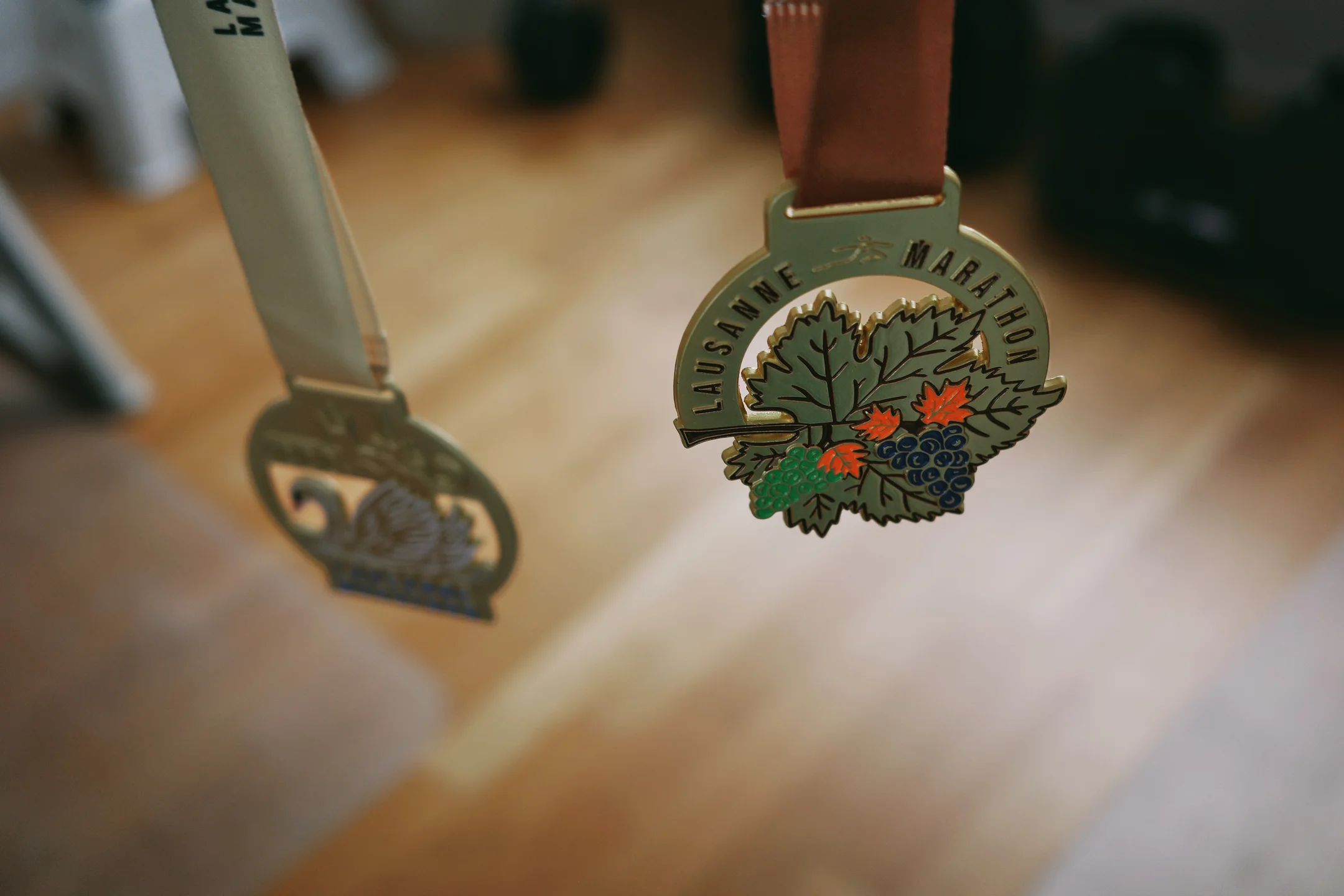
This past Sunday, I ran my second ever marathon. Just like last year, it was in Lausanne.
I’m happy to report that I not only started for the second time, but also finished it for the second time. And I improved my PB by over 5 minutes, from last year’s 4:18:01 to 4:12:25.
Which means I unfortunately didn’t hit my goal of running a sub-4-hour marathon. In retrospect, I’m actually glad that it wasn’t even close; I think that would have felt worse emotionally.
What I’m happy about though is that with my finish time, I ran the whole 42.2 km at a pace starting with a 5. As close as it gets with 5:59 min/km, but still. And under 4:15 h too, which means I was at least faster than the pacemaker from my starting wave.
Overall, the race felt pretty similar to last year’s. So if you want to read a detailed race report that also roughly resembles how I felt this time, go read last year’s post. But there were obviously still a few things that went better than last time (plus some learnings for a potential next time) that I want to focus on in this post.
What went well
I find this graph quite interesting to look at. It’s the data from both my races, as measured by my watch (not official race times), overlaid:
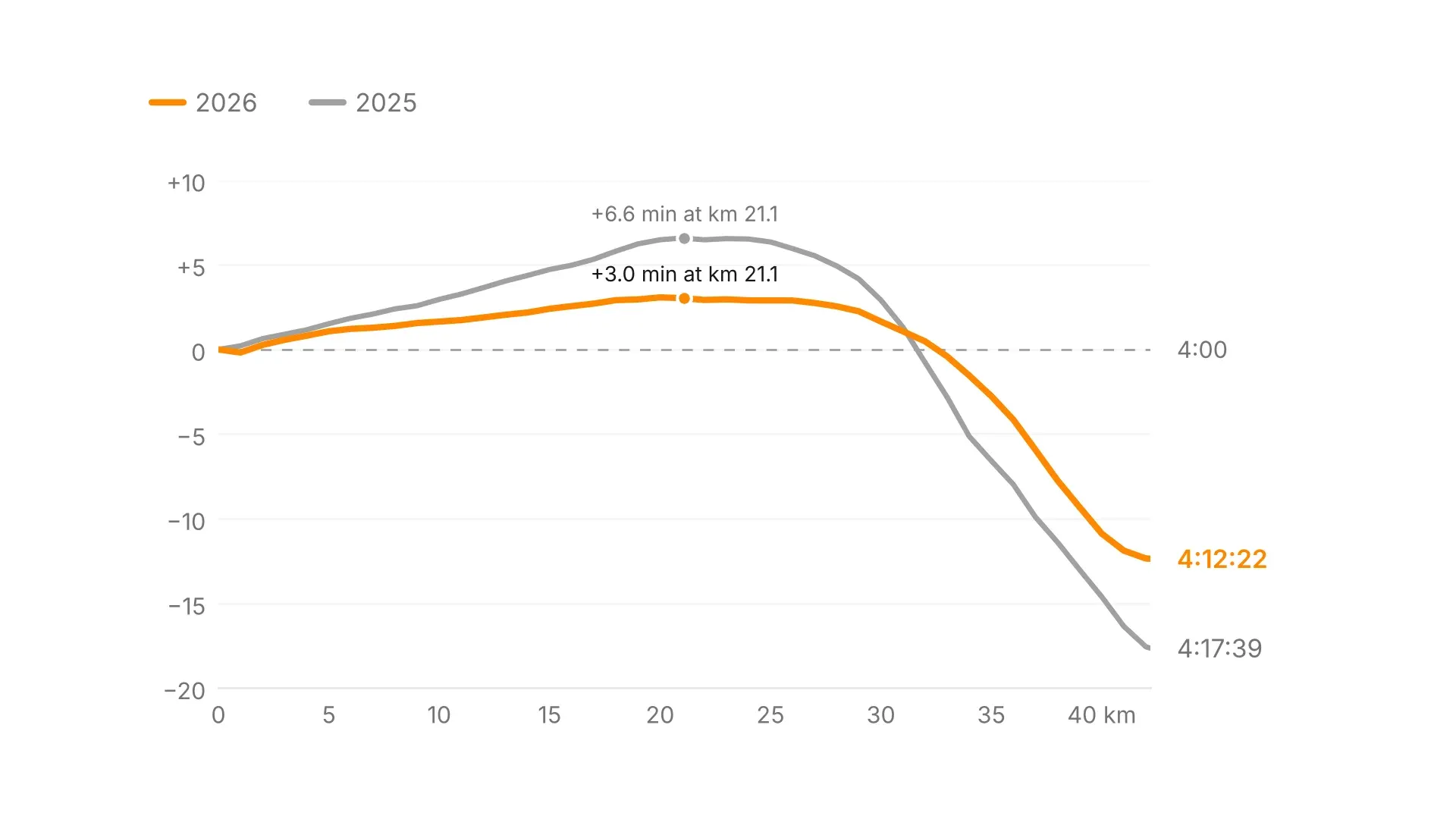
As you can see, I paced myself way better this time. Not as much over-pacing as last time, and the drop-off was way less steep too. But interestingly as well, I lost the sub-4 race at roughly the same spot. Again, 10km before the finish line. More on the reasons later.
Like last year, at some point, I had to resort to my 100m walking, 900m running strategy. But this point came 1 or 2 kilometers later in the race, which I was happy to see.
My fueling strategy was also better than last year’s. I invested in higher-quality gels this time, trained with them, and also tried to increase my intake frequency to about 1 gel every 30 minutes for most of the race, which resulted in a bit more than 50g of carbs per hour. Only in the last ~80 minutes did I have to drop to about half a gel every half hour. Still, a way better strategy than last year’s, when I just took one every 7 kilometers (so about one every 40 minutes). And I had to skip the last one fully, because I felt like I had to throw up otherwise.
My overall preparation for the race was better as well. It included some longer runs (up to 33km, last year’s longest was 30km) that were faster too. I also included more speed work that actually made me faster: I finished the Thuner Stadtlauf, which I raced in August both years, ~1.5 minutes faster (46:41 vs. 48:14) without much difference in effort.
Data points like these show that I theoretically have the aerobic capacity to run a sub-4h marathon. Which brings me to the not-so-great parts.
What still needs some improvement
It was the muscles again. I could start feeling fatigue creep in after 25km or so and then somewhere after 30, the legs were dead again (as you saw above, pretty much in the same spot).
It’s another textbook example of hitting the wall, which is said to cost the average runner about 30 minutes of their total finish time. If I had run my second half as fast as the first one, I would have finished in 3:47h in 2025 and 3:54h in 2026. Which means, in absolute terms, I lost 31 minutes last year and only 18 minutes this year to the wall.
While I tried to incorporate more strength training into my prep, it apparently was still not enough. I’ve now invested in a set of adjustable dumbbells that should give me a bit more flexibility and open up new exercises to target specific muscles in my legs. Over the past year, I mostly relied on bodyweight exercises, which only give you so many options and make it way harder to target specific muscles efficiently. We’ll see how that goes.
My running volume per week during the preparation period was probably also a bit too low. I ran 3 times per week (often in an easy/tempo/long run split), which made my weekly volume peak at 55km. But weekly volume is the training factor often mentioned to be most related to marathon time in amateur runners, so that’s definitely the second area to focus on for the future. Four runs per week aren’t a nice-to-have but a requirement if I really want to improve.
Last but not least, while my fueling was better this year, it was still not enough. For a marathon, it is estimated that you need about 60-90g of carbs per hour. In my case, that means that I should probably take a gel about every 25 minutes instead of every half hour. While it doesn’t seem like that big of a change, over 4 hours, that’s still roughly 2 gels more.
Where to go from here
Last year at this point, I was quite certain that I wanted to run a marathon again.
Now, I don’t feel exactly the same. It’s too early to make a decision yet, but I do wonder if I maybe should pause project “sub 4” a bit and focus more on shorter distances again.
I have a love-hate relationship with training for a marathon. On the one hand, it structures your athletic life in a way that no other sport has for me. You work towards this one big goal, you invest time into it every day and the race day is the big reward where hopefully everything comes together. For example, I quite enjoyed my Saturday morning long runs and was regularly looking forward to them.
On the other hand, training for shorter races and in turn racing more often is honestly more fun. It’s a different kind of training where volume matters less and variability and the (felt) rate of improvement are higher.
So, to sum things up, I don’t yet know how my running year 2027 will go. For now, all I know is that the ’26 season is over.
My current hunch is that I will probably run a half-marathon next year. Either as a standalone race, or as a preparation for a third attempt at the full 42.2 kilometers.
I will let you know.